


Introduction
Understanding Water Damage Claims in UK
Has water ever wreaked havoc in your special sanctuary, your home? Ever been puzzled about what is covered in a water damage claim? If you, like other Cardiff homeowners, have had to grapple with the inevitable stress and financial burden arising from water damage, you’re not alone. Understanding the many facets of water damage claims could be baffling. From deciphering complex insurance language like ‘escape of water’ to knowing what types of water damage are covered, the journey of dealing with your home insurance can feel overwhelming. Fear not, we, at 101 Home Inspection, are here to demystify the finer details of water damage claim coverage for you.
Importance of Knowing Your Coverage
Deciphering your insurance policy and understanding the coverage details are crucial when it comes to making a water damage claim. Knowing the scope and limit of your coverage enables you to assess if the damage falls within the policy parameters and keeps you prepared for out-of-pocket expenses. This understanding forms the cornerstone for effectively claiming water damage on your home insurance.
As a brief snapshot, most home insurance policies generally cover:
- Water damage that is sudden and accidental
- Mitigation efforts to limit damage
- Costs related to repairing damage from the leak
- Costs of replacing damaged building parts
However, they typically exclude coverage for issues like floods, sewer backups, leaks from swimming pools, and gradual damage due to maintenance neglect.
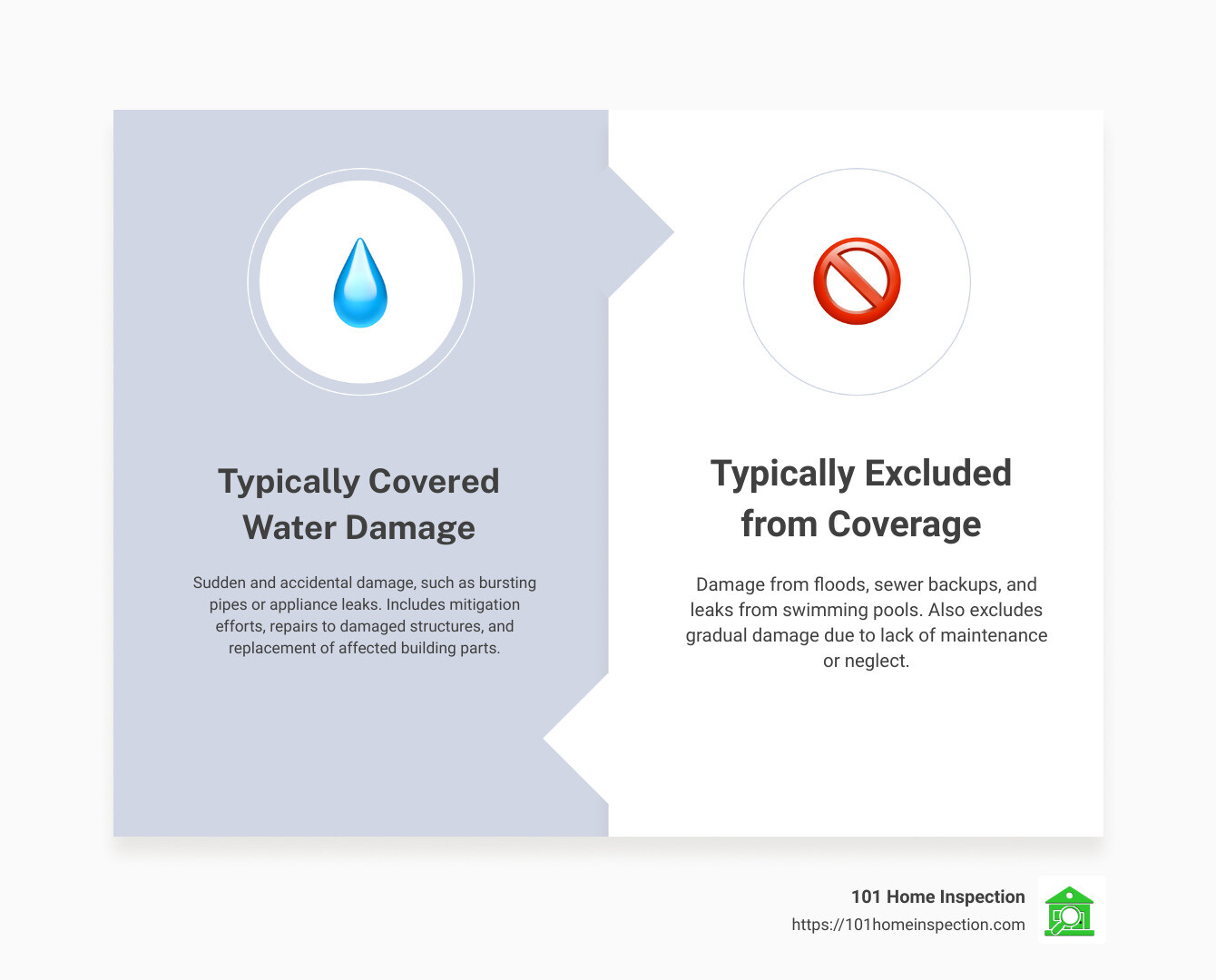
Don’t miss the infographic above for a quick overview of typical coverage terms regarding water damage in home insurance. Stay with us, as we break down the terminology and guide you on your way to becoming an informed homeowner.
Understanding the Types of Water Damage Covered by Insurance
“Escape of Water” Explained
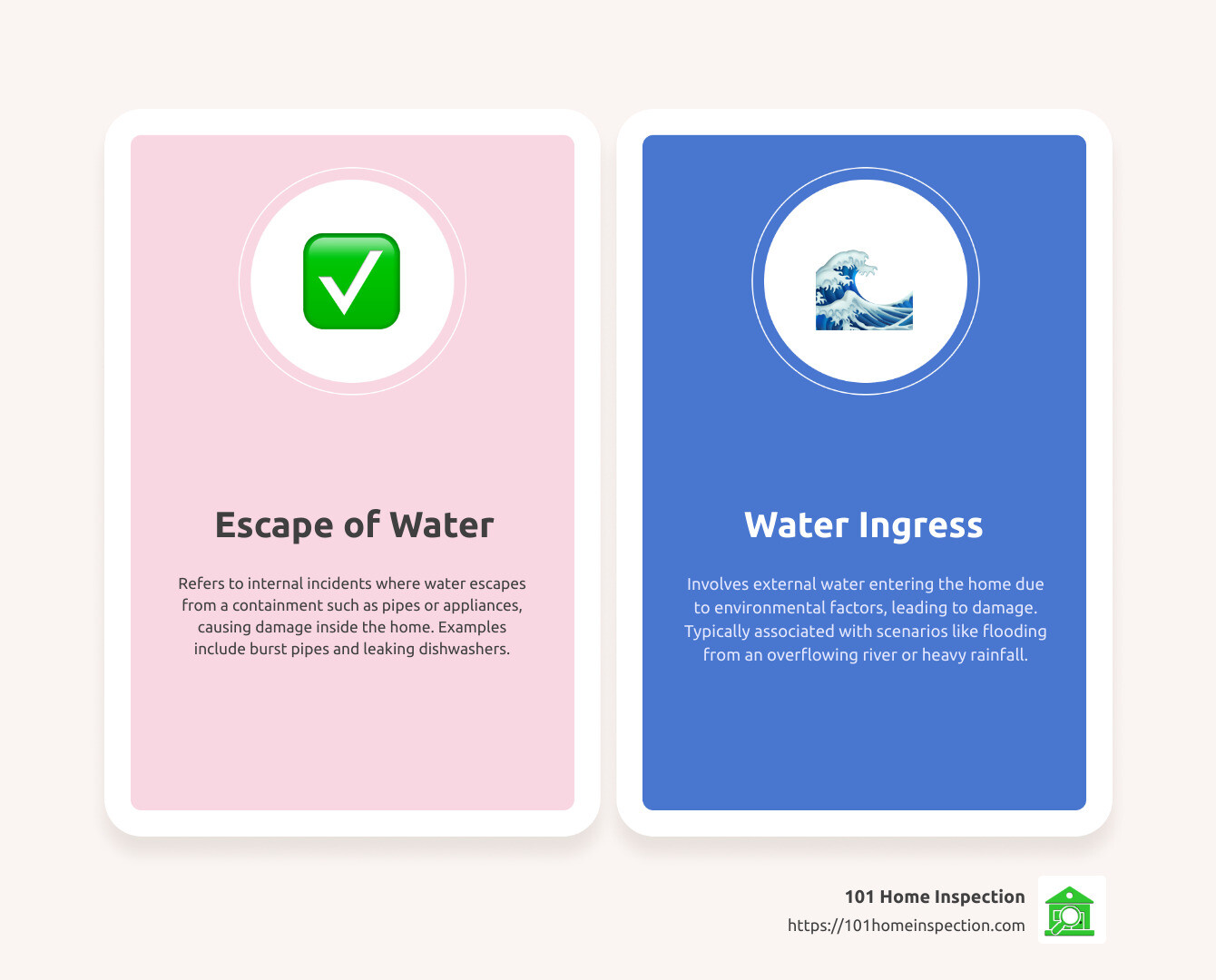
A common term you’ll encounter in your home insurance policy is ‘Escape of Water’. In insurance terms, it refers to scenarios when water has escaped its usual containment, like pipes or appliances, and caused damage to your home. Situations like a burst pipe or a leaking dishwasher fall under this category.
This is a significant concept to understand because most home insurance policies generally cover ‘Escape of Water’ damage. However, do note that the damage to the leaking items themselves won’t be covered unless it’s due to an insured event like a fire or theft.
Differentiating Between “Escape of Water” and “Water Ingress”
It’s crucial to understand the difference between ‘Escape of Water’ and ‘Water Ingress’. ‘Water Ingress’ typically refers to external sources of water entering your home and causing damage, such as a river overflowing its banks or heavy rainfall. This is usually covered under a different section of your policy and is often referred to as flooding.
Remember, ‘Escape of Water’ is usually caused by an internal water source, like a leaking appliance or a burst pipe. It’s essential to check your policy for both escape of water and flooding cover and exclusions.
Coverage for Damage Caused by Leaking Pipes, Tanks, Appliances and Fixed Heating Systems
When it comes to understanding what is covered in a water damage claim, it’s important to know that your home insurance covers water damage as standard. If a water leak damages the structure of your home, this may include damage to things like soaked or warped floorboards. If the leak damages your household items, you may be covered for things like your TV or carpet.
At 101 Home Inspection, our Home Buildings and Contents insurance covers you for the following:
- Freezing of fixed water or fixed heating systems such as burst pipes
- Water leaks from washing machines and dishwashers
- Water leaks from fixed water or fixed heating systems such as pipes and boilers
Cover can vary between insurers, so it’s crucial to check what a policy does and doesn’t include.
Now that we’ve demystified the types of water damage covered by insurance, it’s crucial to understand how to make a successful water leak insurance claim. In the next section, we’ll walk you through the process step-by-step.
The Process of Making a Successful Water Leak Insurance Claim
When you’re hit with a water leak, know how to manage the situation effectively to ensure a successful insurance claim. Here, we’ll guide you through the process of what is covered in a water damage claim.
Immediate Steps to Take When You Notice a Leak
As soon as you notice a leak, act swiftly. The first step is to minimise the damage. Turn off your water supply to prevent further leakage and drain your system. This quick response not only limits the damage but also shows your insurer that you’ve taken reasonable steps to control the situation.
Importance of Recording Evidence for Your Insurance Firm
Next, it’s time to document the leak and the resulting damage. This means taking clear photos and videos of the affected areas, the source of the leak, and any damaged possessions. The more detailed the evidence, the better. This documentation provides invaluable support for your claim.
Contacting Your Insurance Company and Booking a Trace and Access Service
Once you’ve taken the necessary initial steps, contact your insurance company to inform them about the situation. You’ll probably need your policy number and a list of any damaged items.
If the source of the leak is hidden, you may need to book a trace and access service to locate and repair the leak. This service is typically covered under your ‘trace and access’ policy.
Dealing with the Loss Adjuster and Getting Quotes for the Reinstatement Work
After your claim is submitted, your insurance company may send a loss adjuster to assess the damage. Be prepared to provide all your evidence and cooperate fully with their investigation. Once the adjuster has completed their work, you’ll need to get quotes for the reinstatement work needed. It’s crucial to use experienced and reliable tradespeople to ensure the work is carried out to an acceptable standard.
At 101 Home Inspection, we understand how daunting the process of making a water damage insurance claim can be. But with swift action, thorough documentation, and professional advice, you can successfully navigate this process. In the next section, we’ll explore some instances where your claim might not be covered by your insurance company.
What Your Insurance May Not Cover
While homeowners insurance can provide essential financial protection against certain types of water damage, not all water damage incidents are covered. Let’s explore some common situations where your water damage claim might be denied.
When Water Damage Claims Can Be Denied
Some insurance companies, such as Aviva, Lloyds Bank, Admiral and Direct Line, may reject your water damage insurance claim if the cause stems from ‘wear and tear’, which refers to a lack of maintenance, such as worn roof tiles or old grouting around the bath, and extends to pipes that have degraded over time without being repaired.
In addition, these companies will likely refuse if your home has been empty for 60 days or more. Since an unoccupied home may not receive the necessary care and maintenance, insurers consider it a higher risk. Damage resulting from poor installation work can also be a reason for claim denial.
It’s also worth mentioning that certain types of water damage events, like floods, tsunamis, sewer backups, and leaks from swimming pools, are typically not covered by standard homeowner’s insurance policies.
The Role of Wear and Tear, Lack of Maintenance, or Poor Installation Work in Claim Denial
The quality of maintenance and installation of your appliances and plumbing can significantly impact your water damage claim. For example, water leaks caused by old or worn pipes or faulty appliances might not be covered by your insurance policy. These causes are often considered ‘wear and tear’, which is typically not covered by home insurance.
Similarly, if the water damage is a result of poor installation work, your claim can also be denied. This highlights the importance of employing experienced and trusted professionals for any installation work in your home.
At 101 Home Inspection, we understand the complexities involved in understanding what is covered in a water damage claim. We’re here to help you navigate these challenges and ensure the safety of your home. In the next section, we’ll discuss how to protect your home and your claim.
How to Protect Your Home and Your Claim
Understanding what is covered in a water damage claim can be a complex process. But by taking preventative measures and using experienced professionals, you can minimize potential issues and ensure your claim is valid.
Importance of Regular Maintenance and Using Experienced Tradespeople
One fundamental way to protect your home from water damage is by performing regular maintenance. Whether it’s inspecting your roof, gutters, appliances, or plumbing system, prompt detection of potential issues can prevent significant damage. A well-maintained home is less likely to experience severe water damage, which can influence the outcome of your claim positively.
Choosing experienced tradespeople to carry out necessary repairs is crucial. Ineptly executed repairs can lead to further damage and may affect the outcome of your insurance claim. It’s essential to choose tradespeople who can deliver high-quality work, ensuring the longevity and integrity of your property.
Role of Home Improvement and Security Companies Like 101 Home Inspection
At 101 Home Inspection, we play an essential role in protecting your home against water damage and securing your claim. We offer comprehensive home security services, designed to provide you with peace of mind, knowing that your loved ones and property are protected 24/7.
Our team of dedicated professionals carry out detailed inspections, allowing us to detect potential issues early and prevent significant water damage. We also work with a network of experienced tradespeople who can carry out necessary repairs to the highest standard.
When it comes to filing a claim, we’re here to assist you every step of the way. We’ll provide you with the necessary documentation and evidence, making the claim process as smooth as possible.
In conclusion, understanding what is covered in a water damage claim is essential. But equally important is taking proactive steps to protect your home and your claim. By maintaining your home regularly, utilizing experienced tradespeople, and partnering with a trusted home improvement and security company like 101 Home Inspection, you can safeguard your home against water damage and ensure your claim stands up to scrutiny.
In the next section, we’ll explore a real-life example of navigating a water damage claim with professional help. Stay tuned to learn more about this complex process.
Case Study: Navigating a Water Damage Claim with Professional Help
Dealing with a water damage claim may seem daunting, but it becomes manageable when you have the right help. Companies like Aspray provide services that can guide you through the process and ensure a successful outcome.
The Role of Companies Like Aspray in Assisting with Water Damage Claims
Aspray specialises in managing insurance claims and repairs. They handle the entire claim process, from assessing the damage to negotiating with your insurance company and overseeing the repair work. Their role is to ensure that you receive a fair settlement from your insurance company and that the repair work is done to a high standard.
When dealing with a water damage claim, Aspray will assess the full extent of the damage, not just the obvious signs of water leakage. They take into account the damage that can be hidden from view, such as structural damage and potential mould growth. They then compile a detailed report which is then used to negotiate your claim with your insurance company.
A Real-Life Example of a Successful Water Damage Claim
A couple in Northampton faced a stressful situation when they noticed dark marks appearing in their hallway and study. After hiring a leak detection company, they learned about Aspray’s services. Aspray fully assessed the damage to their property and compiled a complete report detailing all damages related to the water damage peril.
With Aspray’s help, the couple’s claim process moved forward smoothly to the reinstatement phase. Aspray managed the claim process, negotiated with the insurance company, and oversaw the repair work to ensure it was done to a high standard. The couple received the payout they were entitled to, and their property was repaired and restored to its pre-damage condition.
This case study illustrates the importance of having professional help when making a water damage claim. It’s not always easy to understand what is covered in a water damage claim, but with the right help, you can navigate the process effectively and ensure a successful outcome.
At 101 Home Inspection, we too are dedicated to helping homeowners in Cardiff, South Wales navigate the complexities of home insurance claims. We understand how stressful it can be to deal with water damage, and we’re here to help you every step of the way, from the initial inspection to the completion of repairs.
Conclusion
Recap of Water Damage Claim Coverage and Process
Navigating the intricacies of what is covered in a water damage claim can be complex. To recap, insurance typically covers water damage resulting from the “escape of water,” like sudden leaks from pipes, tanks, appliances, or fixed heating systems. It’s essential to distinguish this from “water ingress,” which often isn’t covered.
When you notice a leak, take immediate action by documenting evidence and contacting your insurance company. You may need to book a trace and access service to pinpoint the leak’s source. Your insurer may send a loss adjuster if the claim’s cost is substantial.
It’s also necessary to understand that your claim could be denied due to wear and tear, lack of maintenance, or poor installation work. That’s why regular checks and servicing are crucial, as is the quality of the tradespeople carrying out the repairs.
Final Thoughts on Protecting Your Home and Your Insurance Claim
At 101 Home Inspection, we believe in the importance of protecting your home from potential water damage. Regular maintenance, coupled with using experienced tradespeople, can do wonders in preventing leaks and water damage.
Water damage that is “sudden and accidental” is often covered, but gradual problems or maintenance issues are not. Thus, prompt repairs and preventative measures are key to safeguarding your home. Consider steps like draining water heaters twice a year, inspecting hoses regularly, and installing smart water leak detectors.
We’re dedicated to helping homeowners in Cardiff, South Wales navigate the complexities of home insurance claims. While insurance claims can be daunting, with the right knowledge and professional support, it’s possible to navigate these challenges successfully. We’re here to help you every step of the way, ensuring a safe and secure environment for you and your family.