


For many, navigating the complexities of property ownership can be daunting, particularly if you’re outside the main pool of domestic UK buyers asking questions like “who is eligible to buy a house in the UK?”. The layers of criteria and requirements involved give what should be an exciting journey a touch of the ominous. Homeownership should be a dream, not a puzzle. As the folks behind 101 Home Inspection, we empathise with your uncertainties and aim to help you clear a path through the maze of homeownership eligibility.
For those stepping into the UK property market scene, know that your passport does not dictate your eligibility to own a home. Whether you’re a UK native, an expat with less than two years of UK residency, or a foreigner across the borders, the UK property market can accommodate you. It simply boils down to understanding certain key factors and getting your ducks in a row. Are you ready to break into the UK property market? Buckle up, because we have critical information to share and make your journey a whole lot smoother.
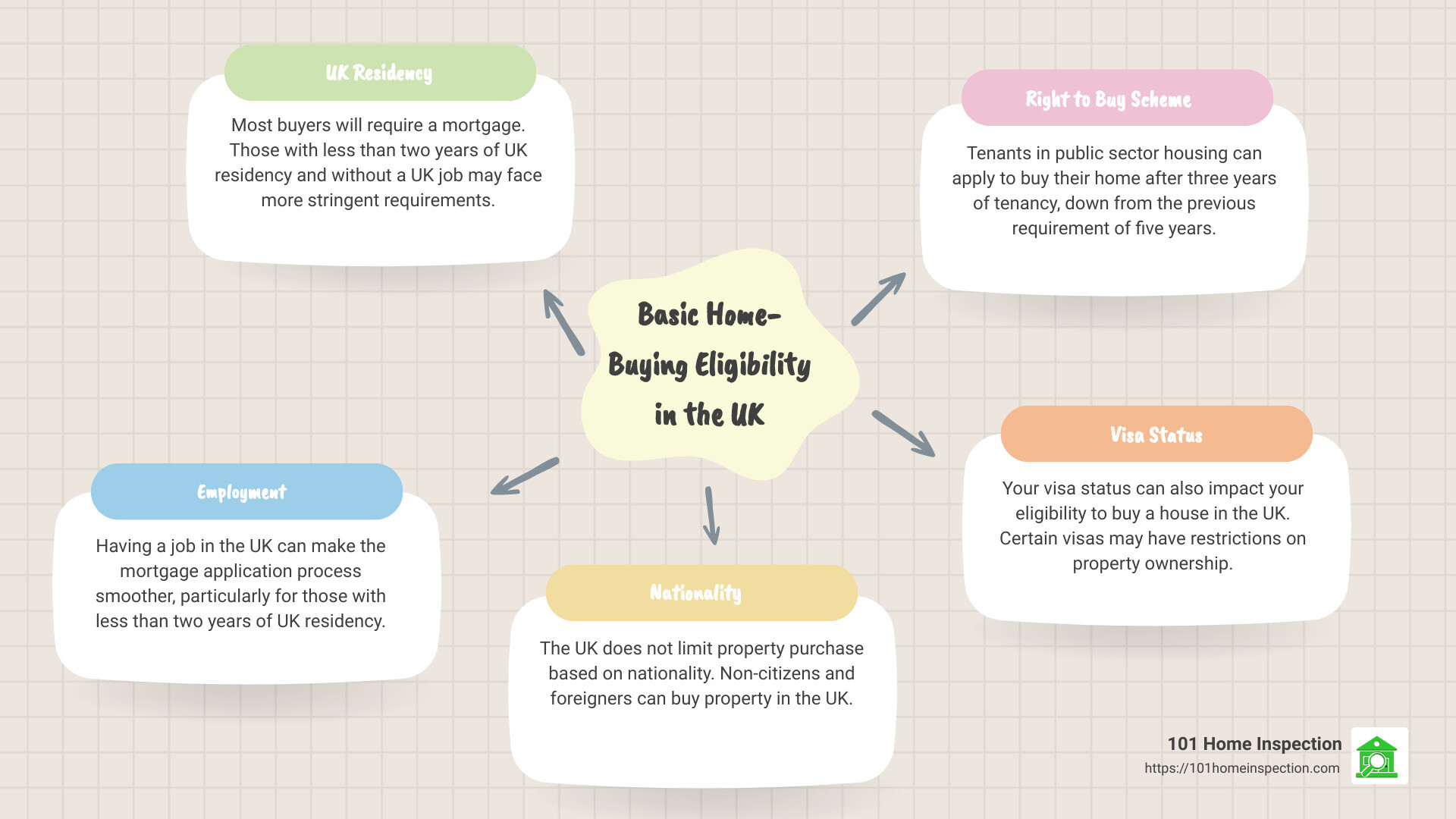
Here’s a snapshot of some of the basic home-buying eligibility criteria in the UK:
- UK Residency and Employment: Most buyers will require a mortgage. Those with less than two years of UK residency and without a UK job may face more stringent requirements.
- Nationality: The UK does not limit property purchase based on nationality. Non-citizens and foreigners can buy property in the UK.
- Right to Buy Scheme: Following changes made in May 2015, tenants in public sector housing can apply to buy their home after three years of tenancy, down from the previous requirement of five years.
Before we get started, here’s an infographic that visually summarizes the basic home-buying eligibility in the UK. To help structure your thinking, it outlines the broad categories we’re going to unpack, including but not limited to the Right to Buy Scheme and the impact of residency on your eligibility.
Whether you’re a foreigner, an expat, or a UK citizen looking to buy a house in the UK, we’re here to ensure you have a clear understanding of the rules, requirements, and nuances involved. Stick with us on this journey and let’s demystify the process together.
Understanding the Basics of Homebuying in the UK
Legal Restrictions and Requirements for Buying a House in the UK
Contrary to common misconceptions, there are no legal restrictions on non-UK residents or foreigners buying property in the UK. This means almost anyone can buy a property there, regardless of nationality. However, to secure a mortgage, certain requirements must be met. For instance, if you are not living in the UK, or haven’t been a resident for at least two years, you may face stricter requirements and be asked for a bigger deposit.
The Impact of Residency and Employment Status on Homebuying
Your residency and employment status can significantly impact your homebuying journey in the UK. If you’ve been a resident for less than two years and you don’t have a job in the UK, lenders may ask for a larger deposit. This is because lenders typically perceive non-residents as higher risk.
However, there’s good news for public sector tenants. If you have been a tenant for 3 or more years, you may be eligible for the Right to Buy scheme, which allows tenants to buy their homes at a discount. This scheme has opened the door to home ownership for many UK residents.
The Role of Nationality in Homebuying
Your nationality plays a less significant role than you might think when it comes to buying a house in the UK. Whether you’re an EU citizen, a non-EU citizen, or a foreigner, you’re allowed to buy a house in the UK. But remember, getting a mortgage might be trickier due to the aforementioned residency and employment factors.
The key takeaway here is that anyone can buy a house in the UK, regardless of their nationality or residency status. However, the process might be a bit more challenging for non-residents and those with less stable employment situations. As with any major financial decision, it’s crucial to do your research and seek professional advice before taking the plunge.
At 101 Home Inspection, we’re here to guide you every step of the way. From helping you understand the potential need for a bigger deposit if you’re a non-resident, to explaining the benefits of the Right to Buy scheme, we’ve got your back.
The Right to Buy Scheme: An Overview
One of the primary ways to buy a home in the UK is through the Right to Buy scheme. It’s a government initiative that enables most public sector tenants to buy their home at a discounted price. However, not everyone is eligible, and there are specific criteria both you and your property need to meet.
Understanding who is eligible to buy a house in the UK through this scheme will help you identify the best way forward in your home-buying journey. So let’s dig into the specifics.
Eligibility Criteria for the Right to Buy Scheme
To apply for the Right to Buy, you need to be a secure tenant of a public sector landlord. The list of these landlords includes district councils, county councils, metropolitan county police authorities, and registered providers such as housing associations, among others.
However, your eligibility also depends on your property. For example, you may not be eligible if your home is suitable for elderly people, is a temporary or moveable dwelling, or if it’s due for demolition.
It’s important to confirm your eligibility with your landlord as part of the Right to Buy application process. You can also use the eligibility quiz on the government’s website to check if you could qualify to buy your home at a discount.
Changes to the Right to Buy Scheme in 2015
There have been changes to this scheme over the years. In May 2015, the eligibility criteria was reduced from five years public sector tenancy to three. This means you now have to be a tenant for three years instead of five before you can apply to buy your home.
Joint Applications and Financing Options for the Right to Buy Scheme
The good news is that you don’t have to do it alone. You can make a joint application for Right to Buy with someone who shares your tenancy, your spouse or civil partner, or up to three family members who have lived with you for the past 12 months. They don’t necessarily have to be part of your tenancy agreement, but it must be their main home.
While there are no specific rules on how a Right to Buy purchase should be financed, it’s essential to note that the legal ownership of the property can only be under the names of the eligible tenant(s) and other eligible applicants.
At 101 Home Inspection, we recommend getting financial and legal advice on mortgages, or you can contact one of the Right to Buy advisers who can point you in the right direction.
As you proceed, beware of individuals or companies offering to help you with your Right to Buy. Remember, they might charge you for their services and may offer a deal that benefits them more than it does you. Always check for any hidden costs before you commit.

The Right to Buy scheme is a fantastic opportunity for eligible individuals to own their homes. Understanding the eligibility criteria and the necessary steps to take can make your home-buying journey smoother and more manageable. As always, we at 101 Home Inspection are here to provide expert guidance and support every step of the way.
Expat Mortgages: What You Need to Know
Expats, or individuals residing outside their native country, often face unique challenges when buying property in the UK. This section will guide you through the key aspects of expat mortgages, including the application and approval process, factors considered by mortgage lenders, and the importance of international employment and income proof.
The Application and Approval Process for Expat Mortgages
Expat mortgages are designed for people who live abroad but want to buy property in the UK. The application process, while similar to standard mortgages, tends to be more rigorous. Lenders usually perceive expats as a higher financial risk, hence the need for an in-depth application review.
The process starts with a thorough check of your credit history. Lenders need to understand your past financial behaviour to assess your ability to repay the loan. This might be straightforward for recent expats, but if you’ve been living abroad for a long time, it might be challenging to trace your UK credit history.
Factors Considered by Mortgage Lenders for Expat Mortgages
Mortgage lenders look at several factors when considering your expat mortgage application. Income and employment are two significant aspects. Lenders will want to see proof of your income, and typically, those working for an international company are more likely to get approved.
If you are self-employed, prepare to show that you use the services of an internationally recognized accountant. Remember, lenders may ask for payslips and other income-related documents translated into English. Some might even require your income to be paid into a UK bank account.
The Impact of International Employment and Income Proof on Expat Mortgages
The nature of your overseas employment and your ability to provide income proof can significantly impact your mortgage application. Lenders generally view expats as higher risk, especially if overseas employment rights and regulations make your income less reliable.
If you work for an international company, your chances of approval are higher than if you work for a local or remote company. Proving your income can be a challenge, but it’s a critical step in getting your mortgage application approved.
As experts in home inspection, we at 101 Home Inspection understand the complexities of buying a property in the UK. Whether you’re an expat or a foreign national, we’re here to provide you with useful guidance to make your home-buying journey as smooth as possible.
Buying Property as a Foreigner in the UK
Moving to the UK and buying a home or investing in the UK property market from abroad might seem daunting. But don’t worry, we’ve got your back. We’ll cover everything from the necessary identity checks to finding the right property and even shed light on potential pitfalls. You will need to get your conveyancing done by a licensed conveyancing service such as My Conveyancing specialist who can provide you with an instant online quote showing all costs.
Identity Checks and Residency Status for Foreign Buyers
The good news is there are no legal restrictions on foreigners buying property in the UK. This means regardless of your nationality, you can buy a property in the UK. However, foreign buyers are often subject to more rigorous identity checks. Be prepared to provide documentation such as ID and proof of address.
It’s important to note that while you don’t need a visa to invest in UK property, if you’re buying a home with the intention of living in it, you will need the appropriate visa and residence permit.
Average House Prices and Regional Variations in the UK
Understanding the property market in the UK is crucial for a successful purchase. The UK property market has been a roller coaster ride with surging property prices in recent years, driven by high demand and limited supply. However, as of January 2023, there were signs that UK house prices were starting to fall.
According to figures from the Land Registry, the average UK property price in January 2023 was £290,000. But remember, property prices can vary considerably between regions and depending on the property type. For instance, the average cost of a detached property was £458,066 while a flat sold for £227,951. London, as expected, had the highest average property price at £533,986.
Finding a Property: Estate Agents and Online Property Websites
Once you have a good grasp of the property market and your budget, it’s time to find your perfect property. Real estate agents and online property websites are extremely helpful in this process. Estate agents can provide a wider set of property options and help you understand the local processes better. They can even help arrange mortgages or solicitors, making your home-buying journey a lot smoother.
Online real estate websites are also a great way to start your house hunt. They offer a vast array of property listings and allow you to filter and sort properties based on your preferences.
Potential Pitfalls of Buying Property in the UK as a Foreigner
While the process of buying property in the UK is largely straightforward, there are potential pitfalls that foreign buyers should be aware of. These could include not fully understanding the property market fluctuations, overpaying for a property, or getting caught up in a complicated and lengthy buying process.
This is where we can step in. At 101 Home Inspection, we can provide a thorough home inspection to assess the safety and condition of the property. Our team of experts can help ensure that you make a solid investment and find a safe, beautiful home for yourself.
In conclusion, while the process of buying a property in the UK as a foreigner comes with its challenges, with the right guidance and preparation, it’s an entirely achievable goal.
The Process of Buying a House in the UK
Now that we’ve covered the eligibility criteria for homebuying in the UK, let’s delve into the actual process of buying a house. It’s important to understand each step, from setting a budget to completing the purchase.
Setting a Budget and Getting Finances in Order
The first thing you need to do is calculate your budget. Take into account your savings, income and any loans or mortgages you may be eligible for. It’s important to accurately calculate your budget to avoid future financial difficulties. If you’re a foreigner or an expat, it’s crucial to get professional help such as a real estate agent, a lender, or an attorney to avoid potential pitfalls (source: getgoldenvisa.com).
Making an Offer and Applying for a Mortgage
After finding your dream property, it’s time to make an offer. Once the offer is accepted, you’ll need to apply for a mortgage. Remember, as a foreigner or non-resident, it’s possible to get a mortgage in the UK, but there might be more stringent requirements and possibly a bigger deposit (source: getgoldenvisa.com).
Appointing a Solicitor and Arranging a Home Survey
Next, you’ll need to appoint a solicitor to handle the legal aspects of the purchase. They will help bring the sale process to an agreement. It’s also advisable to arrange for a house survey to assess the condition of the property. At 101 Home Inspection, we provide comprehensive home inspection services to ensure the safety and condition of the property.
Exchanging Contracts and Completing the Purchase
The final steps involve exchanging contracts and completing the purchase. This is where you make your down payment, sign the contracts, and finalize the mortgage process. After this, the property is legally yours.
Just remember, buying a property in the UK as a foreigner or non-resident can be a complex process, but with the right planning and professional help, it can be a smooth and successful journey. Whether you’re an expat, a non-EU citizen or just someone wondering ‘who is eligible to buy a house in uk’, this guide provides a solid starting point for your homebuying journey.
Additional Costs and Considerations When Buying a House in the UK
Understanding ‘who is eligible to buy a house in the UK’ is only the first step. Once you’ve sorted eligibility, it’s essential to be aware of the extra costs and considerations linked to homebuying.
Fees and Taxes Involved in Buying and Owning Property in the UK
Buying a property in the UK involves more than just the purchase price. Certain fees and taxes increase the overall cost by around 10%. Here’s a quick rundown:
- Stamp duty: If the property exceeds £125,000, you’ll pay this tax, which ranges from 2 to 12%.
- Deposit: If you’re getting a mortgage, expect to pay a deposit between 5 and 40% of the property price.
- Mortgage expenses: These include arrangement fees, booking fees, and valuation fees.
- Legal fees: You’ll need a solicitor or conveyancer to manage the legal side of things.
- Land registry fees: These fees enable the transfer of the property’s legal deeds to you.
The Importance of Opening a UK Bank Account or Using a Wise Account
For seamless monetary transactions, consider opening a UK bank account or using a service like Wise. The latter allows you to send money worldwide quickly, securely, and at low fees, making it ideal for managing cross-border payments.
The Role of Home Inspection in the Homebuying Process
Don’t underestimate the importance of a thorough home inspection. It’s a small investment that can save you from costly surprises down the line. At 101 Home Inspection, we offer expert home inspection services to give you peace of mind as you embark on your homebuying journey.
In conclusion, understanding the eligibility criteria, costs, and other aspects of buying a home in the UK can make the process smoother and less daunting. Good luck with your homebuying journey!
In conclusion, the homebuying process in the UK can be complex, particularly for those who are not UK citizens or residents. However, understanding who is eligible to buy a house in the UK and the various requirements and schemes available can make the process much easier to navigate.
Whether you’re a UK resident, a foreigner, or a non-resident, you have the opportunity to own property in the UK. Remember, it’s not just about meeting the eligibility criteria but also understanding the financial implications and legal requirements. This includes understanding the ins and outs of mortgages, the Right to Buy scheme, and the specific considerations for expat mortgages and foreign buyers.
At 101 Home Inspection, we’re here to assist you on this journey. We understand how important it is to have a safe and secure home, and we strive to provide comprehensive home inspection services to ensure that your new home meets your expectations.
And remember, there are always professionals and resources available to you such as the Money and Pensions Service, The Leasehold Advisory Service (LEASE), and The Financial Conduct Authority (FCA), who can provide further guidance and advice. Don’t hesitate to seek help when you need it.
Entering the property market is a big step, but with the right knowledge and support, it can be an exciting and rewarding journey. Happy homebuying!